Research & Tech Tree Guide
Research runs on exploration points, not on time alone: survey a point, cash the data in at a research facility, then buy upgrades tier by tier — Tier 2 unlocks the second planet's build set.
Research is the spine of Star Trek: Outposts Unknown. It is how a camp becomes an outpost, how an outpost reaches a second planet, and how the game converts exploration into power. It is also the system new captains under-fund, because it does not look urgent next to a power outage.
Where research actually comes from
Research is not a timer you start and forget. It runs on exploration points: you find a point of interest, survey it, and the data has to be cashed in through a research facility before it turns into anything you can buy. Exploration points come in tiers, and the higher tiers are gated behind the lower ones plus the equipment to reach them.
That produces a natural rhythm. Survey a cluster of points, return, spend the data, spend the resulting materials, then push the frontier outward again. An outpost that stops surveying stops researching, no matter how many labs it owns.
The five-tier ladder
The achievement list names the ladder explicitly: Tier 2 and Tier 5 both have achievements, and a separate achievement exists for buying every upgrade in the tree. Five tiers is the shape to plan around.
| Tier | What it is for | Rough cost profile |
|---|---|---|
| Tier 1 | Basic harvesting, storage, first structures | Cheap, fast, no rare inputs |
| Tier 2 | Better processing, second-planet build set | Metal-heavy, needs a stable chain |
| Tier 3 | Shields, vehicles, advanced facilities | Rare materials, compute |
| Tier 4 | Precision upgrades, expanded networks | Multi-step crafting |
| Tier 5 | Endgame upgrades | Everything you have been stockpiling |
Tier 2 is the real gate. Everything before it is tutorial-adjacent; everything after it assumes you can produce advanced components on demand. Do not enter Tier 3 while your compute line is marginal, because that is exactly when shields and vehicles start competing for the same components.
What to buy first
Order of purchase for a first campaign:
- Harvest and haul improvements. Anything that shortens a trip or increases a collector's yield pays for itself every minute of the run.
- Storage and filters. Overflow is silent waste; fixing it early is cheaper than fixing a stalled chain later.
- Water and power capacity. Not because they are fun, but because everything else assumes surplus.
- Compute capacity. This is the research multiplier. Two labs with compute out-research four labs without.
- Shield emitters. Before the first serious Tetryon event, not after.
- Vehicles. Ground first, air once you can afford the hangar — air vehicles carry four crew in one trip and change how far your outpost effectively reaches.
Upgrades are permanent, and there are enough of them that "buy everything" is a legitimate long-term goal rather than a joke. But buying an upgrade you cannot supply is worse than leaving the point unspent.
Research facilities and the network

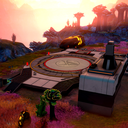
Research outposts generate and store data on-site. Official media: Magic Fuel Games / Playstack.
A single lab on the first planet will carry you through Tier 2. Past that, research becomes a network problem: facilities on different worlds each contribute, and the outpost that is best placed to survey a given region is usually not the one with the best labs. Shuttling data is cheaper than duplicating a full research campus on every planet, which is why the transfer network matters more than raw lab count.
The practical build is one strong research hub plus small survey outposts that feed it. That structure also survives setbacks better: losing a survey post costs you a week of data, losing your hub costs you the run.
Exploration points, tiers and prerequisites
Tier 3 exploration points sit in places Tier 1 gear cannot reach, and the game is not subtle about it — the point is visible, the survey is unavailable. Read that as a shopping list rather than a bug. The prerequisites are usually one of: a vehicle to cross terrain, a shielded structure to survive the local radiation, or a crew specialist whose skill unlocks the action.
That is why the tree and the crew system are one system wearing two hats. A point that needs a Science officer is not a research problem, it is a staffing problem, and the fastest fix is usually a promotion or a reassignment rather than another upgrade.
A research plan that finishes
If you want a single recommendation: rush Tier 2, consolidate, then aim every subsequent point at shields and vehicles before anything cosmetic. A campaign that finishes inside 60 in-game days — one of the harder achievements — is almost always a campaign that spent its research on movement and survival rather than on breadth.