Planets & Exploration Guide
Three planets, three economies. Daegus is the temperate start, Korou hides resources under ice and volcano, Neral is the hostile last stop. Clear fog of war outward from your landing zone.
Star Trek: Outposts Unknown spreads a full campaign across three worlds, and each one is a different economy rather than a different colour palette. Knowing what a planet supplies before you land is the difference between an outpost that pays for itself and one you abandon.
Daegus: the temperate start
Daegus is the demo planet and the tutorial in disguise. A temperate oasis in the middle of the system, it also carries a rocky desert of sun-baked stone and dramatic crystal monuments, which means one landing can reach three distinct resource profiles.
What it is good for: food and organics, early metal, and the flat ground you need for a clean first layout. The crystal formations are also where several survey points sit, so the planet keeps paying past the tutorial.
What it lacks: the rare materials that shields and vehicles need. Daegus teaches you the loop; it does not finish the campaign for you.
Korou: ice, fire, and the organic bottleneck
Korou — spelled Kourou in the planet-reveal devlog — is the game's argument that biome design is mechanics. The X'Lehari abandoned it after the Tetryon Rift escalated, leaving structures and people who would rather not be found.
| Zone | Terrain | What it gives you | What it costs you |
|---|---|---|---|
| Glaciers | Slow-moving ice sheets | Resources buried beneath the surface | Survey time, cold exposure |
| Volcanic badlands | Trenches, magma, fire | Heat, mineral wealth | Damage, route closures |
| Steam fields | Superheated water vents | The planet's only organic material | Access, crew safety |
The cold is not flavour text: there is an achievement for losing a crew member to it on Korou. Insulate quarters, keep medical staffed, and do not send a survey team out without a route back to a heated building.
Neral: the hostile last stop
Neral is the third and final planet, showcased at Gamescom, and the developers describe it as the most hostile environment in the game with challenges at every turn. It has three biomes of its own, and it is where the campaign's story converges.
Practical implication: Neral is not a place to establish a fresh self-sufficient outpost from scratch. Arrive with a supply line, shields already built, and vehicles ready. Treat it as an expedition with a base camp rather than a colony.
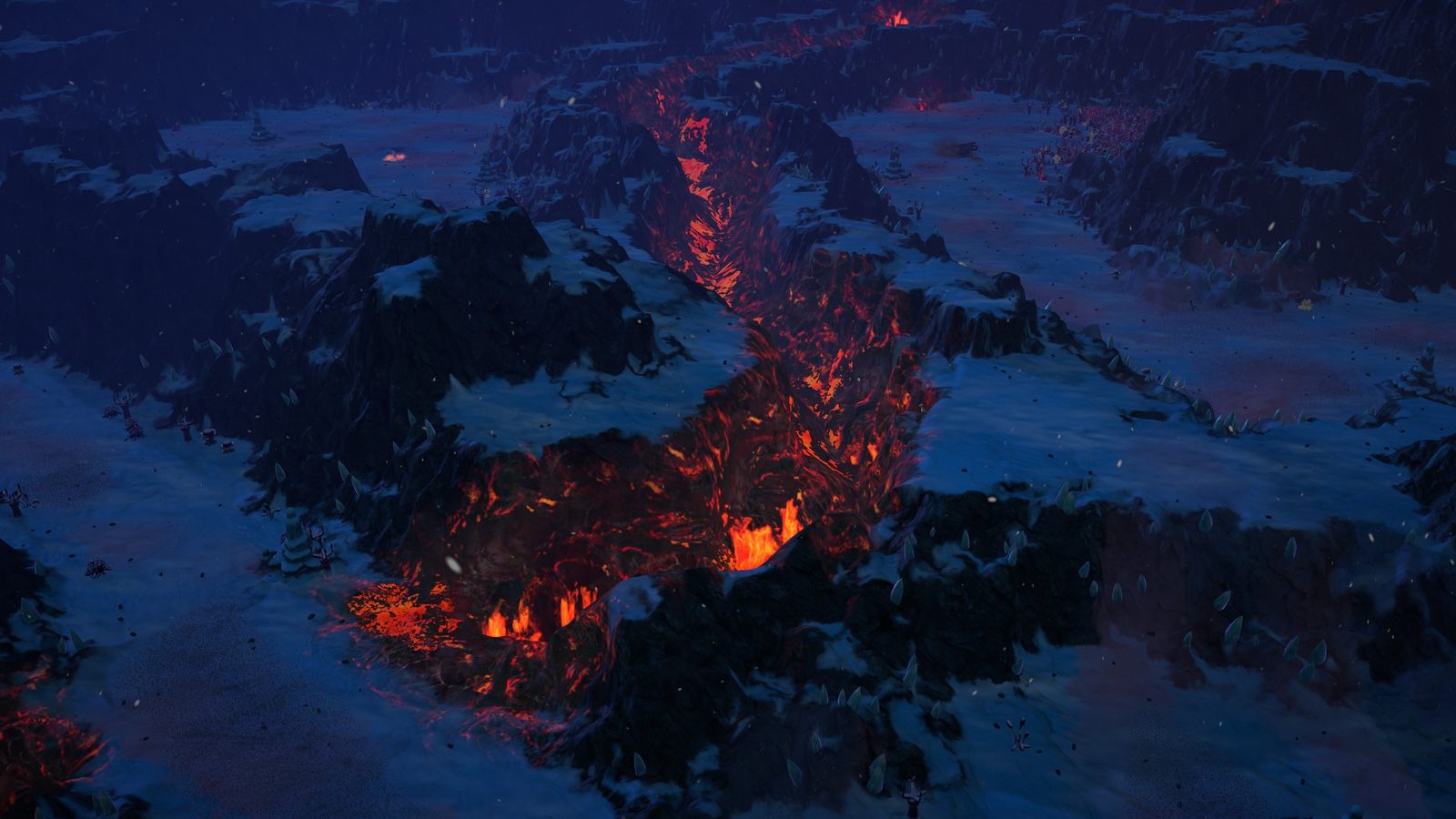
Each world has its own biome set and resource profile. Official media: Magic Fuel Games / Playstack.
Fog of war and how exploration pays
Every planet starts under fog. Clearing it is not cosmetic: survey points, resources and story beats all sit in the dark, and one achievement asks you to clear a whole planet, another to clear every planet you visit.
The efficient pattern is radial rather than exhaustive. Push outward from the landing zone in wedges, clear a wedge, survey what is inside it, then move to the next. Zig-zag exploration spends travel time three times over and leaves half-cleared patches that are hard to finish later.
Why vehicles matter more than transporters
Tetryon interference blocks free beaming across the planet. That is the in-fiction reason you cannot teleport a survey team to the far ridge, and it is why vehicles exist: ground and air transport are the practical answer to distance.
An air vehicle carries four crew in one trip, which is an achievement and also the single biggest quality-of-life upgrade in the mid-game. Once you have it, a survey that used to take a full day becomes an afternoon, and your outpost effectively doubles its reachable radius overnight.
Planet priority
| Priority | Planet | When to land | Why |
|---|---|---|---|
| 1 | Daegus | Immediately | Teaches the loop, feeds the first base |
| 2 | Korou | After Tier 2 | Rare materials and organics under ice |
| 3 | Neral | After shields and air vehicles | Hostile; needs a supply line, not a colony |
Landing on Korou early is tempting and usually a mistake: without insulated quarters and medical cover, the cold turns a resource trip into a crew loss you cannot replace.